Fluid Mechanics - Semester Exam Question
Home ->
ChE Learning Resources
-> Question Bank
Unit-2 Excercises
Mass Balance: (Equation of Continuity)
- A water tank has an inflow line 1 ft in diameter and two 1/2 ft diameter outflow lines. The velocity in the inflow line is 5 ft/sec. The mass of water in the tank is not changing with time. What are the volumetric flow rate, mass flow rate, and the velocity in the other outflow line? Answer: 2.55 ft3/sec, 159 lb/sec, 13 ft/sec.
- A lake has a surface area of 100 km2. One river is bringing water into the lake at a rate of 10,000 m3/s, while another is taking water out at 8000m3/s. Evaporation and seepage are negligible. How fast is the level of the lake rising or falling? Answer: 72mm/h
- A vacuum chamber has a volume of 10 ft3. When the vacuum pump is running, the steady-state pressure in the chamber is 0.1 lbf/in2. The pump is shut off, and the following pressure-time data are observed:
Time after shutoff, min	Pressure, psia
	0		0.1
	10		1.1
	20		2.1
	30		3.1
Calculate the rate of air leakage into the vacuum chamber when the pump is running. Air may be assumed to be a perfect gas. The air temperature may be assumed constant at 70oF. Answer: 0.0051 lb/min.
Energy Balance: (Bernoulli's equation)
- The tank in fig1 is cylindrical and has a vertical axis. Its horizontal cross-sectional area is 100 ft2. The hole in the bottom has a cross-sectional area of 1 ft2. The interface between the gasoline and the water remains perfectly horizontal at all times. The interface is now 10 ft above the bottom. How soon will gasoline start to flow out the bottom? Assume frictionless flow. Sp.gr of gasoline:0.72 . Answer: 36.5 sec.
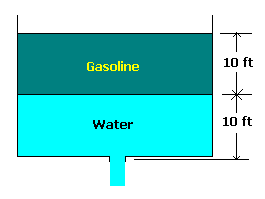
Fig1- In the vessel in fig2 water is flowing steadily in frictionless flow under the barrier. What is the velocity of the water flow under the barrier? Answer: 11.3 ft/sec.
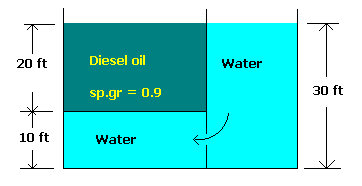
Fig2
- In the tank in fig3 water is under a layer of compressed air, which is at a pressure of 20 psig. The water is flowing out through a frictionless nozzle, which is 5 ft below the water surface. What is the velocity of the water? Answer: 57.4 ft/sec.
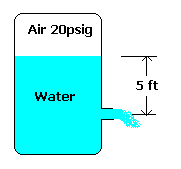
Fig3
Incompressible One-dimensional Frictional Flow:
Water is flowing through a horizontal tube with 1.00 in inside diameter. What is the maximum average velocity at which laminar flow will be of stable flow pattern? What is the pressure drop per unit length at this velocity? Answer: 2.8 ft/sec; 2.08 X 10⁻⁴ psi/ft.
A fluid is flowing in a pipe. The pressure drop is 10 lbf/(in2.1000 ft). We now double the flow rate, holding the diameter and fluid properties constant. What is the pressure drop if the new Reynolds number (a) is 10 and (b) is 108? Answer: 20 psi per 1000 ft; 35 to 40 psi per 1000 ft.
Two tanks are connected by 500 ft of 3 in pipe. The tanks contain an oil with m = 100 cP and r = 0.85 g/cc. The level in the first tank is 20 ft above the level in the second, and the pressure in the second is 10 psi greater than the pressure in the first. How much oil is flowing through the pipe? Which way is it flowing? Answer: 40 gal/min; from the second tank to the first tank.
Two large water are connected by a 10 ft piece of 3 in pipe. The levels in the tank are equal. When the pressure difference between the tanks is 30 psi, what is the flow rate through the pipe? Answer: 1040 gal/min.
We are going to lay a length of 6 in steel pipe for a long distance and allow water to flow through it by gravity. If we want a flow rate of 500 gal/min, how much must we slope the pipe (i.e., by how many feet of drop per foot of pipe length)? Answer: .0166 ft/ft.
[Index] [ Get More Questions with Solutions from Our Online Course...]
Last Modified on: 04-Feb-2022
Chemical Engineering Learning Resources - msubbu
e-mail: learn[AT]msubbu.academy
www.msubbu.in